Who knows you matters more than what you know because, for authors, opportunities move through people. Readers, podcast hosts, event planners, and booksellers act on recommendations from people they trust, and those people only recommend the authors they remember. Being remembered rarely comes from your credentials. It comes from what you gave before you asked for anything.
It used to be what you know. Then it was who you know. Now it is who knows you. When an opportunity comes up, people do not remember your bio or your follower count. They remember how you made them feel and what you gave: your time, your energy, your knowledge. SpeakrBrand calls this Earn Trust Before Hello.
TLDR
- Most book discovery runs on recommendation. In a 2025 NPR/Ipsos poll, 55% of American readers said friends or family inspire what they read.
- Research on LinkedIn shows that the people who open new doors are often acquaintances rather than your inner circle.
- Authors such as Tim Ferriss, James Clear, and Austin Kleon became known by giving value long before they asked for a sale.
- On LinkedIn, consistent generosity compounds: useful posts, real stories, thoughtful comments, and introductions with no ask attached.
Why Does Who Knows You Matter More Than What You Know for Authors?
Who knows you matters more for authors because many readers choose books on someone else’s word. Expertise makes a good book possible. A trusted recommendation puts it in a reader’s hands.
In an NPR/Ipsos poll of 2,033 American adults in February 2025, 55% of readers said they get their inspiration on what to read or listen to from friends or family. In Canada, BookNet’s Canadian Leisure and Reading Study 2025 found word of mouth was again the top way readers discovered books, chosen by 36% of readers.
A reader is far more likely to pick up your book because someone they trust mentioned it than because they read your credentials.
What Changed From What You Know to Who Knows You?

FIG.33A · Three eras of opportunity: what you know, who you know, and who knows you. Tap to open full size.
What changed is that a wide network of people who remember you now opens more doors than a small circle who owe you favors. Your close contacts hear about the same opportunities you do. The people at the edge of your network hear about everything else.
Stanford sociologist Mark Granovetter made that argument in his 1973 paper The Strength of Weak Ties. Researchers later tested it on LinkedIn. According to MIT News, the experiment ran from 2015 through 2019 and involved about 20 million LinkedIn users and 600,000 new jobs. Weak ties beat strong ones, and moderately weak ties, people you know a little, were the most useful.
For authors, those ties are the podcast host who saw your post last spring and the conference organizer who read your comment on a friend’s post. They owe you nothing. They remember you because you gave them something useful.
What Do People Remember When an Opportunity Comes Up?
People remember how you made them feel and what you gave without asking for anything back. Credentials fade. A useful idea or a kind introduction stays.
The saying “they may forget what you said, but they will never forget how you made them feel” is often credited to Maya Angelou. Quote Investigator traced it to a 1971 collection that attributed it to Carl W. Buehner.
Organizational psychologist Adam Grant studied the pattern at work. In Give and Take, he describes givers as people who contribute to others without expecting anything in return. In Harvard Business Review, he lists what that looks like day to day: offering assistance, sharing knowledge, and making valuable introductions. Those are the things people recall when someone asks for an author who could speak to a topic.
Tim Ferriss used that approach to launch The 4-Hour Workweek in 2007. On his blog, he explained that before writing the book he interviewed close to a dozen best-selling authors about their marketing, then skipped book touring and bookstore signings entirely. He spent his time where bloggers gathered instead, crediting a summary by PR writer Steve Rubel for the rules he followed:
“Be there with a message and a story that will appeal to their interests, not yours.” (Tim Ferriss, quoting Steve Rubel’s summary of the launch)
The book reached number one on The New York Times list, first carried by people who knew him before they knew the book.
How Do Authors Become Known Before They Ask for Anything?
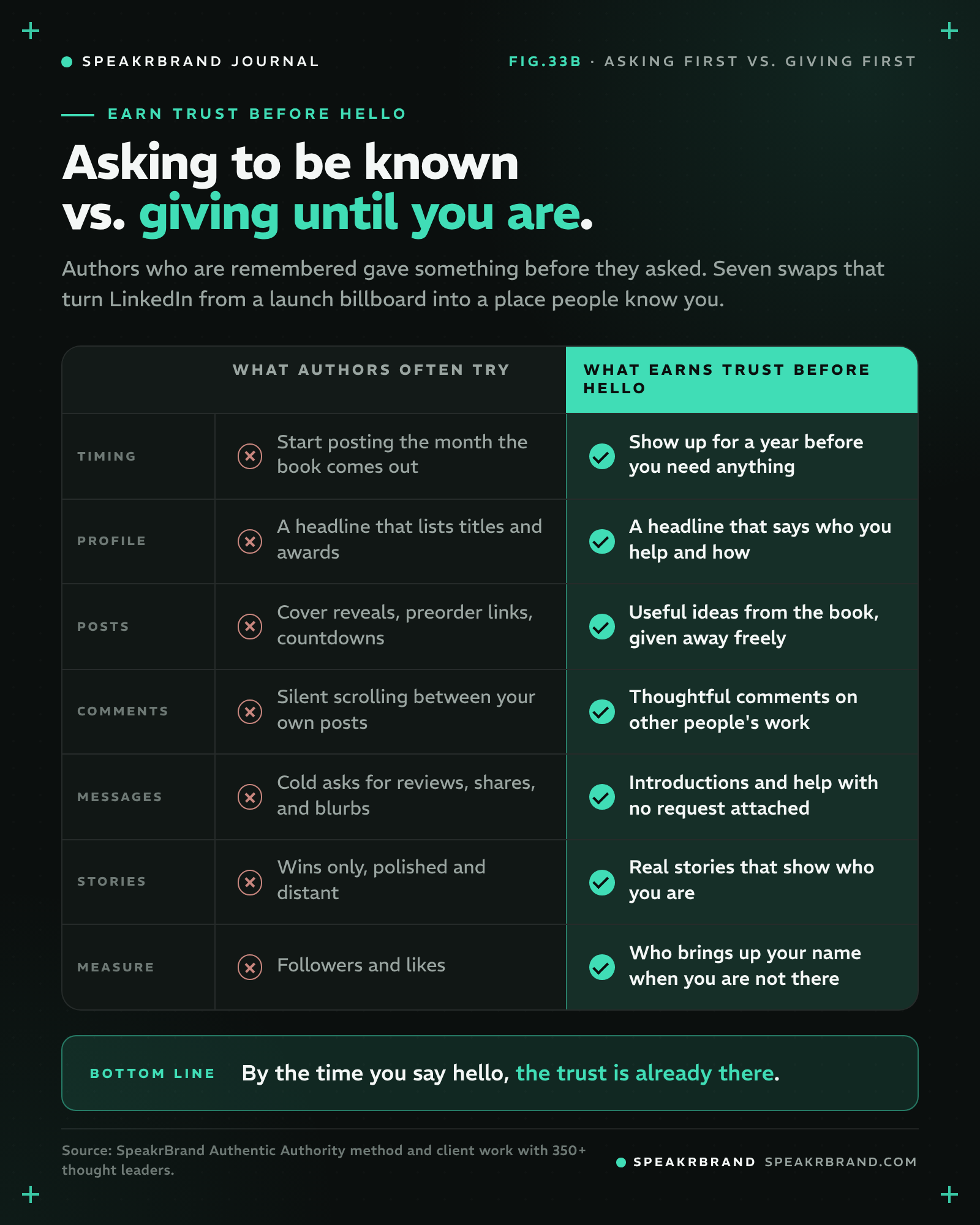
FIG.33B · Asking to be known vs. giving until you are, seven LinkedIn swaps for authors. Tap to open full size.
Authors become known by giving their best thinking away in public, consistently, long before launch day.
James Clear is a clear example. On his about page, he notes that he has been writing about habits at JamesClear.com since 2012, that his 3-2-1 newsletter reaches more than 3 million subscribers each week, and that Atomic Habits has sold more than 30 million copies. Years of free, useful writing came first.
Austin Kleon describes Show Your Work as a book for people who hate the very idea of self-promotion, built on influencing others by letting them learn from what you share. Kevin Kelly’s essay 1,000 True Fans describes the payoff: a true fan buys the hardback, the paperback, and the audio version.
On LinkedIn, SpeakrBrand teaches this through Authentic Authority: Stories, Personal, Insights, and Proof in a 30/20/30/20 mix. Stories and personal posts let people know you. Insights and proof show you know your subject.
Try this first
For seven days, give on LinkedIn without asking. Leave three thoughtful comments on posts by people your readers follow, make one introduction, and share one useful idea from your book with no buy link. Then note who replied and who started a conversation.
How Does LinkedIn Turn Generosity Into Being Remembered?
LinkedIn turns generosity into memory because every useful post, comment, and introduction is seen by people at the edge of your network, the same acquaintances the research shows open new doors.
The 2024 LinkedIn and Edelman B2B thought leadership research cites the 95-5 rule: only about 5% of potential buyers in a category are in the market at any given time. The same research found that 52% of decision-makers spend an hour or more each week reading thought leadership, and 75% say a piece of it led them to research something they were not considering before.
In SpeakrBrand’s work with 350+ thought leaders, the authors whose launches feel easiest are usually the ones who spent the year before helping other people in public. If your launch is close, start with a plan to build a LinkedIn audience in the 90 days before a book launch, and borrow from these book launch LinkedIn ideas for authors.
Frequently Asked Questions
What does “who knows you” mean for an author?
For an author, “who knows you” means the people who remember you well enough to recommend you when an opportunity comes up. That includes readers, podcast hosts, event planners, and other authors. It is built by giving value in public over time, not by collecting contacts.
How can an author get known on LinkedIn without self-promotion?
An author can get known on LinkedIn by sharing useful ideas from the book, telling real stories, and leaving thoughtful comments on other people’s posts. Promotion works better after that trust exists.
How long does it take to build a reputation before a book launch?
Building a reputation that carries a launch usually takes months of consistent posting and engagement, and ideally a year or more. Authors with a launch inside 90 days should start immediately and focus on giving value first.
What is Earn Trust Before Hello?
Earn Trust Before Hello is SpeakrBrand’s idea that your content should earn someone’s trust before your first conversation with them. For authors, it means readers and partners already know your thinking before you ask for a review, a booking, or a sale. It is the principle behind SpeakrBrand’s LinkedIn Content Strategy work.
Start this week: help five people your readers already trust, and post one idea from your book someone could use today. If you want help turning that habit into a LinkedIn content strategy, SpeakrBrand’s social media marketing team builds it with authors, speakers, and business leaders, and our branding work makes sure what people remember about you is the right thing.
Who knows you matters more than what you know because, for authors, opportunities move through people. Readers, podcast hosts, event planners, and booksellers act on recommendations from people they trust, and those people only recommend the authors they remember. Being remembered rarely comes from your credentials. It comes from what you gave before you asked for anything.
It used to be what you know. Then it was who you know. Now it is who knows you. When an opportunity comes up, people do not remember your bio or your follower count. They remember how you made them feel and what you gave: your time, your energy, your knowledge. SpeakrBrand calls this Earn Trust Before Hello.
TLDR
- Most book discovery runs on recommendation. In a 2025 NPR/Ipsos poll, 55% of American readers said friends or family inspire what they read.
- Research on LinkedIn shows that the people who open new doors are often acquaintances rather than your inner circle.
- Authors such as Tim Ferriss, James Clear, and Austin Kleon became known by giving value long before they asked for a sale.
- On LinkedIn, consistent generosity compounds: useful posts, real stories, thoughtful comments, and introductions with no ask attached.
Why Does Who Knows You Matter More Than What You Know for Authors?
Who knows you matters more for authors because many readers choose books on someone else’s word. Expertise makes a good book possible. A trusted recommendation puts it in a reader’s hands.
In an NPR/Ipsos poll of 2,033 American adults in February 2025, 55% of readers said they get their inspiration on what to read or listen to from friends or family. In Canada, BookNet’s Canadian Leisure and Reading Study 2025 found word of mouth was again the top way readers discovered books, chosen by 36% of readers.
A reader is far more likely to pick up your book because someone they trust mentioned it than because they read your credentials.
What Changed From What You Know to Who Knows You?
FIG.33A · Three eras of opportunity: what you know, who you know, and who knows you. Tap to open full size.
What changed is that a wide network of people who remember you now opens more doors than a small circle who owe you favors. Your close contacts hear about the same opportunities you do. The people at the edge of your network hear about everything else.
Stanford sociologist Mark Granovetter made that argument in his 1973 paper The Strength of Weak Ties. Researchers later tested it on LinkedIn. According to MIT News, the experiment ran from 2015 through 2019 and involved about 20 million LinkedIn users and 600,000 new jobs. Weak ties beat strong ones, and moderately weak ties, people you know a little, were the most useful.
For authors, those ties are the podcast host who saw your post last spring and the conference organizer who read your comment on a friend’s post. They owe you nothing. They remember you because you gave them something useful.
What Do People Remember When an Opportunity Comes Up?
People remember how you made them feel and what you gave without asking for anything back. Credentials fade. A useful idea or a kind introduction stays.
The saying “they may forget what you said, but they will never forget how you made them feel” is often credited to Maya Angelou. Quote Investigator traced it to a 1971 collection that attributed it to Carl W. Buehner.
Organizational psychologist Adam Grant studied the pattern at work. In Give and Take, he describes givers as people who contribute to others without expecting anything in return. In Harvard Business Review, he lists what that looks like day to day: offering assistance, sharing knowledge, and making valuable introductions. Those are the things people recall when someone asks for an author who could speak to a topic.
Tim Ferriss used that approach to launch The 4-Hour Workweek in 2007. On his blog, he explained that before writing the book he interviewed close to a dozen best-selling authors about their marketing, then skipped book touring and bookstore signings entirely. He spent his time where bloggers gathered instead, crediting a summary by PR writer Steve Rubel for the rules he followed:
“Be there with a message and a story that will appeal to their interests, not yours.” (Tim Ferriss, quoting Steve Rubel’s summary of the launch)
The book reached number one on The New York Times list, first carried by people who knew him before they knew the book.
How Do Authors Become Known Before They Ask for Anything?
FIG.33B · Asking to be known vs. giving until you are, seven LinkedIn swaps for authors. Tap to open full size.
Authors become known by giving their best thinking away in public, consistently, long before launch day.
James Clear is a clear example. On his about page, he notes that he has been writing about habits at JamesClear.com since 2012, that his 3-2-1 newsletter reaches more than 3 million subscribers each week, and that Atomic Habits has sold more than 30 million copies. Years of free, useful writing came first.
Austin Kleon describes Show Your Work as a book for people who hate the very idea of self-promotion, built on influencing others by letting them learn from what you share. Kevin Kelly’s essay 1,000 True Fans describes the payoff: a true fan buys the hardback, the paperback, and the audio version.
On LinkedIn, SpeakrBrand teaches this through Authentic Authority: Stories, Personal, Insights, and Proof in a 30/20/30/20 mix. Stories and personal posts let people know you. Insights and proof show you know your subject.
Try this first
For seven days, give on LinkedIn without asking. Leave three thoughtful comments on posts by people your readers follow, make one introduction, and share one useful idea from your book with no buy link. Then note who replied and who started a conversation.
How Does LinkedIn Turn Generosity Into Being Remembered?
LinkedIn turns generosity into memory because every useful post, comment, and introduction is seen by people at the edge of your network, the same acquaintances the research shows open new doors.
The 2024 LinkedIn and Edelman B2B thought leadership research cites the 95-5 rule: only about 5% of potential buyers in a category are in the market at any given time. The same research found that 52% of decision-makers spend an hour or more each week reading thought leadership, and 75% say a piece of it led them to research something they were not considering before.
In SpeakrBrand’s work with 350+ thought leaders, the authors whose launches feel easiest are usually the ones who spent the year before helping other people in public. If your launch is close, start with a plan to build a LinkedIn audience in the 90 days before a book launch, and borrow from these book launch LinkedIn ideas for authors.
Frequently Asked Questions
What does “who knows you” mean for an author?
For an author, “who knows you” means the people who remember you well enough to recommend you when an opportunity comes up. That includes readers, podcast hosts, event planners, and other authors. It is built by giving value in public over time, not by collecting contacts.
How can an author get known on LinkedIn without self-promotion?
An author can get known on LinkedIn by sharing useful ideas from the book, telling real stories, and leaving thoughtful comments on other people’s posts. Promotion works better after that trust exists.
How long does it take to build a reputation before a book launch?
Building a reputation that carries a launch usually takes months of consistent posting and engagement, and ideally a year or more. Authors with a launch inside 90 days should start immediately and focus on giving value first.
What is Earn Trust Before Hello?
Earn Trust Before Hello is SpeakrBrand’s idea that your content should earn someone’s trust before your first conversation with them. For authors, it means readers and partners already know your thinking before you ask for a review, a booking, or a sale. It is the principle behind SpeakrBrand’s LinkedIn Content Strategy work.
Start this week: help five people your readers already trust, and post one idea from your book someone could use today. If you want help turning that habit into a LinkedIn content strategy, SpeakrBrand’s social media marketing team builds it with authors, speakers, and business leaders, and our branding work makes sure what people remember about you is the right thing.