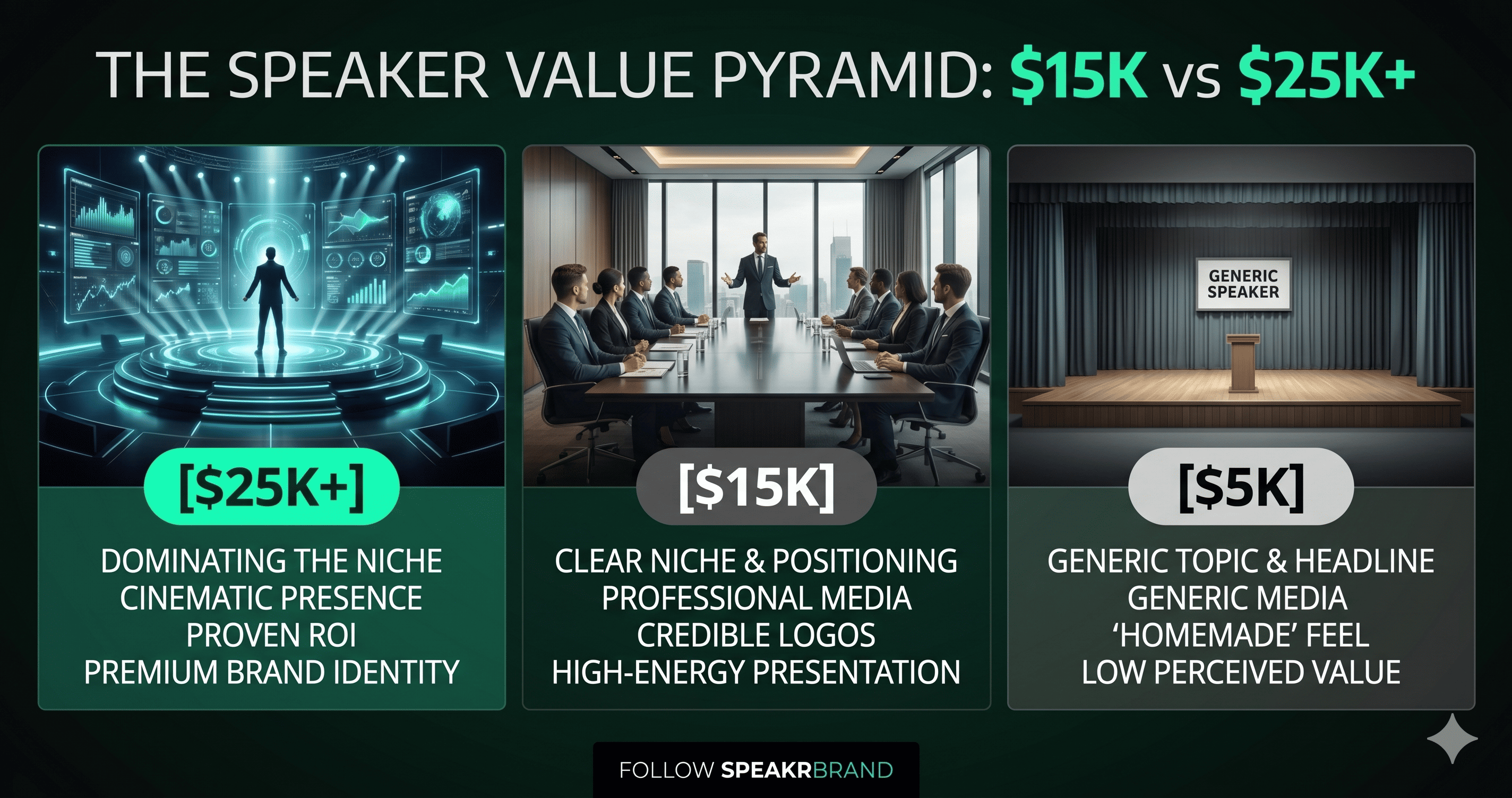
To build a personal brand with authenticity and authority, you show people who you are and what you know in the same stretch of time, on purpose. Authentic content makes people trust you as a person. Authority content makes them see you as the expert. A keynote speaker who runs only one half ends up liked but not booked, or respected but not remembered.
The speakers people follow for years tend to post a big stage and an ordinary Tuesday in the same week. SpeakrBrand calls that mix Authentic Authority, and it sits inside the 5P Playbook: Positioning, Presence, Proof, Proximity, and Promotion.
TLDR
- Research on first impressions keeps finding two judgments: warmth (do I trust you?) and competence (can you deliver?). A personal brand has to answer both.
- Authenticity without authority reads like a friend. Authority without authenticity reads like a résumé.
- Mel Robbins, Steven Bartlett, Brené Brown, and Gary Vaynerchuk each pair visible struggle or process with clear expertise.
- The 5P Playbook gives every part of your brand an authentic move and an authority move.
Why Does a Personal Brand Need Both Authenticity and Authority?

FIG.34A · The authenticity and authority matrix: friend, résumé, invisible, or both. Tap to open full size.
A personal brand needs both because people judge you on two questions at once: do I trust this person, and can this person deliver? Answer only one, and the event planner, the bureau, or the executive buyer moves on to someone who answers both.
Social psychologists Susan Fiske, Amy Cuddy, and Peter Glick summarized that pattern in Universal dimensions of social cognition: warmth and competence in 2007. People perceived as warm and competent draw uniformly positive reactions. People seen as high on one and low on the other draw what the authors call ambivalent reactions. For a speaker, ambivalent is the inquiry that never comes.
In Connect, Then Lead in Harvard Business Review, Cuddy, Matthew Kohut, and John Neffinger noted that leaders often lead with competence, strength, and credentials, and that without a foundation of trust, that approach risks fear, resentment, or envy.
“The best way to gain influence is to combine warmth and strength.” (Amy Cuddy, Matthew Kohut, and John Neffinger, Harvard Business Review)
Frances Frei and Anne Morriss name authenticity, logic, and empathy as the three core drivers of trust in Begin With Trust. A feed full of credentials supplies logic and leaves out the other two.
What Do Speakers With Both Halves Actually Share?
Speakers with both halves share the struggle and the process alongside the stage and the results. The human side gives people a reason to care. The expert side gives them a reason to hire.
Mel Robbins opens her About page with the hard part before the accomplishments. She writes that at 41 she was unemployed, drowning in debt, and could barely get out of bed. Only then does the page turn to the authority: The Mel Robbins Podcast, The Let Them Theory, and books translated into 66 languages. The order matters. You meet the person, then the proof.
Steven Bartlett tells a similar story on his own site. He says he started The Diary Of A CEO in 2017, on his own, sharing his personal diary every Sunday while he ran Social Chain. The show became a long-form interview program, and he joined BBC One’s Dragons’ Den in 2021. The authentic habit came first.
Brené Brown may be the clearest case of both halves in one sentence. On her About page, she describes herself as a researcher and storyteller, then lists the credentials: research professor at the University of Houston and author of six number one New York Times bestsellers. Her 2010 talk The power of vulnerability pairs her research with her own reaction to it. “Maybe stories are data with soul,” she writes.
Gary Vaynerchuk turned the authentic half into a content rule. In Document, Don’t Create, published in 2016, he argues that sharing your process works better than overselling yourself:
“I think it’s much more fruitful to talk about your process than about the actual advice you ‘think’ you should be giving them.” (Gary Vaynerchuk)
How Do You Build Authenticity and Authority Into the 5P Playbook?

FIG.34B · An authentic move and an authority move for each part of the 5P Playbook. Tap to open full size.
You build both into the 5P Playbook by giving each P a human move and an expert move. The 5P Playbook shows you what to build. Authentic Authority is how you market it.
- Positioning. Pair one clear promise with the lived reason you care about it. Planners remember a speaker who owns a single idea, which is the heart of becoming a category of one.
- Presence. In the same week, post a stage moment or an insight and a behind-the-scenes moment: the draft slide, the rehearsal, the flight delay that changed your opening.
- Proof. Keep the testimonials, reel, one-pager, and website current, and tell results as stories, with the client’s permission, so proof reads as a lesson rather than a trophy.
- Proximity. Help peers in public with no ask attached. Opportunities move through people who remember you, which is why who knows you matters more than what you know.
- Promotion. Open outreach with the planner’s event and audience, then name the specific outcome you deliver.
On LinkedIn, SpeakrBrand runs this through the Authentic Authority content method: Stories and Personal posts on the authentic side, Insights and Proof on the authority side, in a 30/20/30/20 mix. In SpeakrBrand’s work with 350+ thought leaders, the half that goes missing is usually the authentic one. The stage photos and announcements are there. The person is not.
Try this first
Pull up your last ten LinkedIn posts. Mark each one A for authentic (a story, a behind-the-scenes moment, something personal) or B for authority (an insight, a result, a stage moment). If either letter shows up fewer than three times, your next two posts belong to that side.
How Do You Stay Authentic Without Oversharing or Sounding Generic?
You stay authentic by sharing what is true and useful to your audience, and by letting your voice grow as your work grows. Authentic does not mean confessional, and it does not mean frozen.
INSEAD professor Herminia Ibarra warns in The Authenticity Paradox that people often use authenticity as an excuse to stick with what is comfortable. She recommends an “adaptively authentic” approach and advises leaders not to cling to an outdated version of “your story.”
Generic content is now the bigger risk. In July 2026, Originality.ai analyzed 5,000 public LinkedIn posts of at least 100 words and classified 81.2% as likely AI-written. The same report notes that LinkedIn is rolling out a “Seems like AI slop” feedback option. When most posts sound alike, a real story is the part no one else can copy.
Authority still has to be earned with substance. In the 2024 LinkedIn and Edelman B2B thought leadership research, only 15% of decision-makers described the thought leadership they read as very good, and 55% named strong research and data as a top trait of high-quality work.
Authenticity without authority is a friend. Authority without authenticity is a résumé. Buyers book the speaker who is both.
Frequently Asked Questions
What is the difference between authenticity and authority in a personal brand?
Authenticity is what makes people trust you as a person: your stories, your process, and your values. Authority is what makes them see you as the expert: your insights, results, and credentials. A strong personal brand shows both so people want to follow you and feel safe hiring you.
How often should a speaker post authentic content versus authority content?
SpeakrBrand recommends a roughly even split: 30% Stories and 20% Personal on the authentic side, 30% Insights and 20% Proof on the authority side. The exact ratio matters less than never letting either side disappear for weeks.
Can you be too authentic on LinkedIn?
Yes, when personal posts stop connecting to the problem you solve. If a story neither teaches your audience something nor shows how you work, keep it for a smaller circle.
How does the 5P Playbook relate to Authentic Authority?
The 5P Playbook (Positioning, Presence, Proof, Proximity, Promotion) is SpeakrBrand’s framework for what a speaker brand needs. Authentic Authority is the content method that markets it, mainly powering Presence and Promotion and feeding Proof.
Start with the ten-post audit this week, then fill the thinner side first. If you want help building a brand that shows both the person and the expert, SpeakrBrand’s branding team works with keynote speakers on positioning, proof, and the presence that earns trust before hello.
To build a personal brand with authenticity and authority, you show people who you are and what you know in the same stretch of time, on purpose. Authentic content makes people trust you as a person. Authority content makes them see you as the expert. A keynote speaker who runs only one half ends up liked but not booked, or respected but not remembered.
The speakers people follow for years tend to post a big stage and an ordinary Tuesday in the same week. SpeakrBrand calls that mix Authentic Authority, and it sits inside the 5P Playbook: Positioning, Presence, Proof, Proximity, and Promotion.
TLDR
- Research on first impressions keeps finding two judgments: warmth (do I trust you?) and competence (can you deliver?). A personal brand has to answer both.
- Authenticity without authority reads like a friend. Authority without authenticity reads like a résumé.
- Mel Robbins, Steven Bartlett, Brené Brown, and Gary Vaynerchuk each pair visible struggle or process with clear expertise.
- The 5P Playbook gives every part of your brand an authentic move and an authority move.
Why Does a Personal Brand Need Both Authenticity and Authority?
FIG.34A · The authenticity and authority matrix: friend, résumé, invisible, or both. Tap to open full size.
A personal brand needs both because people judge you on two questions at once: do I trust this person, and can this person deliver? Answer only one, and the event planner, the bureau, or the executive buyer moves on to someone who answers both.
Social psychologists Susan Fiske, Amy Cuddy, and Peter Glick summarized that pattern in Universal dimensions of social cognition: warmth and competence in 2007. People perceived as warm and competent draw uniformly positive reactions. People seen as high on one and low on the other draw what the authors call ambivalent reactions. For a speaker, ambivalent is the inquiry that never comes.
In Connect, Then Lead in Harvard Business Review, Cuddy, Matthew Kohut, and John Neffinger noted that leaders often lead with competence, strength, and credentials, and that without a foundation of trust, that approach risks fear, resentment, or envy.
“The best way to gain influence is to combine warmth and strength.” (Amy Cuddy, Matthew Kohut, and John Neffinger, Harvard Business Review)
Frances Frei and Anne Morriss name authenticity, logic, and empathy as the three core drivers of trust in Begin With Trust. A feed full of credentials supplies logic and leaves out the other two.
What Do Speakers With Both Halves Actually Share?
Speakers with both halves share the struggle and the process alongside the stage and the results. The human side gives people a reason to care. The expert side gives them a reason to hire.
Mel Robbins opens her About page with the hard part before the accomplishments. She writes that at 41 she was unemployed, drowning in debt, and could barely get out of bed. Only then does the page turn to the authority: The Mel Robbins Podcast, The Let Them Theory, and books translated into 66 languages. The order matters. You meet the person, then the proof.
Steven Bartlett tells a similar story on his own site. He says he started The Diary Of A CEO in 2017, on his own, sharing his personal diary every Sunday while he ran Social Chain. The show became a long-form interview program, and he joined BBC One’s Dragons’ Den in 2021. The authentic habit came first.
Brené Brown may be the clearest case of both halves in one sentence. On her About page, she describes herself as a researcher and storyteller, then lists the credentials: research professor at the University of Houston and author of six number one New York Times bestsellers. Her 2010 talk The power of vulnerability pairs her research with her own reaction to it. “Maybe stories are data with soul,” she writes.
Gary Vaynerchuk turned the authentic half into a content rule. In Document, Don’t Create, published in 2016, he argues that sharing your process works better than overselling yourself:
“I think it’s much more fruitful to talk about your process than about the actual advice you ‘think’ you should be giving them.” (Gary Vaynerchuk)
How Do You Build Authenticity and Authority Into the 5P Playbook?
FIG.34B · An authentic move and an authority move for each part of the 5P Playbook. Tap to open full size.
You build both into the 5P Playbook by giving each P a human move and an expert move. The 5P Playbook shows you what to build. Authentic Authority is how you market it.
- Positioning. Pair one clear promise with the lived reason you care about it. Planners remember a speaker who owns a single idea, which is the heart of becoming a category of one.
- Presence. In the same week, post a stage moment or an insight and a behind-the-scenes moment: the draft slide, the rehearsal, the flight delay that changed your opening.
- Proof. Keep the testimonials, reel, one-pager, and website current, and tell results as stories, with the client’s permission, so proof reads as a lesson rather than a trophy.
- Proximity. Help peers in public with no ask attached. Opportunities move through people who remember you, which is why who knows you matters more than what you know.
- Promotion. Open outreach with the planner’s event and audience, then name the specific outcome you deliver.
On LinkedIn, SpeakrBrand runs this through the Authentic Authority content method: Stories and Personal posts on the authentic side, Insights and Proof on the authority side, in a 30/20/30/20 mix. In SpeakrBrand’s work with 350+ thought leaders, the half that goes missing is usually the authentic one. The stage photos and announcements are there. The person is not.
Try this first
Pull up your last ten LinkedIn posts. Mark each one A for authentic (a story, a behind-the-scenes moment, something personal) or B for authority (an insight, a result, a stage moment). If either letter shows up fewer than three times, your next two posts belong to that side.
How Do You Stay Authentic Without Oversharing or Sounding Generic?
You stay authentic by sharing what is true and useful to your audience, and by letting your voice grow as your work grows. Authentic does not mean confessional, and it does not mean frozen.
INSEAD professor Herminia Ibarra warns in The Authenticity Paradox that people often use authenticity as an excuse to stick with what is comfortable. She recommends an “adaptively authentic” approach and advises leaders not to cling to an outdated version of “your story.”
Generic content is now the bigger risk. In July 2026, Originality.ai analyzed 5,000 public LinkedIn posts of at least 100 words and classified 81.2% as likely AI-written. The same report notes that LinkedIn is rolling out a “Seems like AI slop” feedback option. When most posts sound alike, a real story is the part no one else can copy.
Authority still has to be earned with substance. In the 2024 LinkedIn and Edelman B2B thought leadership research, only 15% of decision-makers described the thought leadership they read as very good, and 55% named strong research and data as a top trait of high-quality work.
Authenticity without authority is a friend. Authority without authenticity is a résumé. Buyers book the speaker who is both.
Frequently Asked Questions
What is the difference between authenticity and authority in a personal brand?
Authenticity is what makes people trust you as a person: your stories, your process, and your values. Authority is what makes them see you as the expert: your insights, results, and credentials. A strong personal brand shows both so people want to follow you and feel safe hiring you.
How often should a speaker post authentic content versus authority content?
SpeakrBrand recommends a roughly even split: 30% Stories and 20% Personal on the authentic side, 30% Insights and 20% Proof on the authority side. The exact ratio matters less than never letting either side disappear for weeks.
Can you be too authentic on LinkedIn?
Yes, when personal posts stop connecting to the problem you solve. If a story neither teaches your audience something nor shows how you work, keep it for a smaller circle.
How does the 5P Playbook relate to Authentic Authority?
The 5P Playbook (Positioning, Presence, Proof, Proximity, Promotion) is SpeakrBrand’s framework for what a speaker brand needs. Authentic Authority is the content method that markets it, mainly powering Presence and Promotion and feeding Proof.
Start with the ten-post audit this week, then fill the thinner side first. If you want help building a brand that shows both the person and the expert, SpeakrBrand’s branding team works with keynote speakers on positioning, proof, and the presence that earns trust before hello.