The assets that win a booking are decision tools, not branding exercises. A planner building a shortlist, a committee making a call, and an assistant running a background check at eleven o'clock on a Thursday night each lean on a specific asset to reduce the risk of choosing the wrong speaker. When any one of those assets is weak, the entire case for booking you weakens with it.
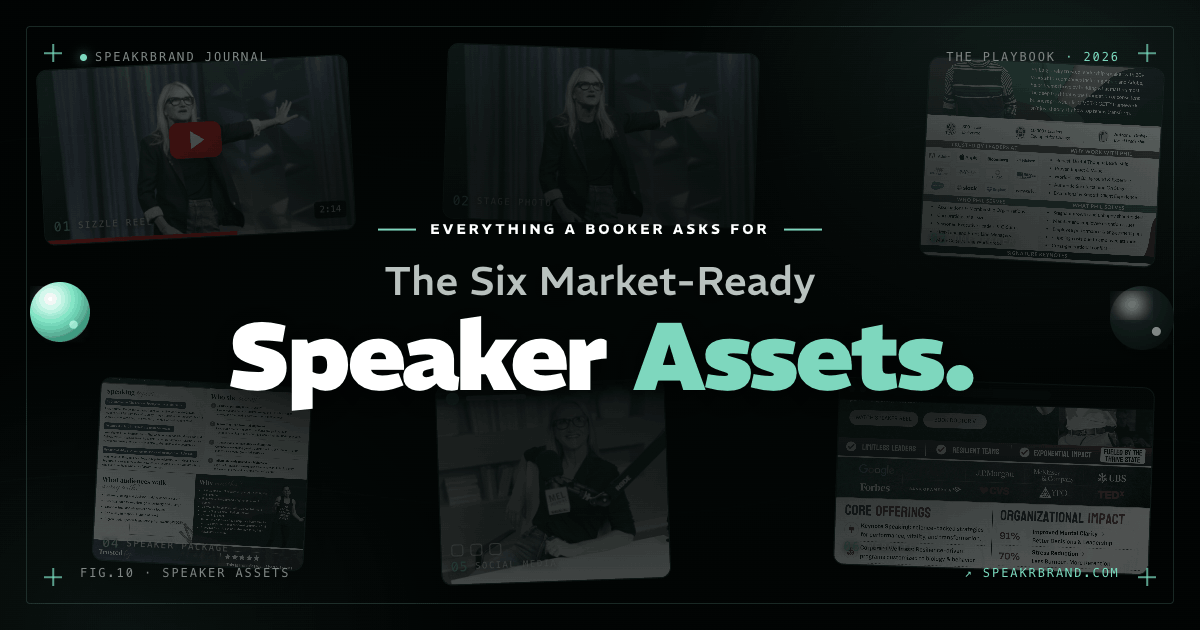
Five assets do the heavy lifting: professional photos, the speaker website, the reel, the one-pager, and the full speaker package. Each exists to do a defined job at a moment of evaluation, and the work is largely silent, happening while you are nowhere near the room. That matters because Gartner reports buyers spend only 17 percent of their purchase time with potential suppliers, leaving most of the decision to independent research where your materials speak for you. Decision-makers also weigh that evidence heavily, since Edelman research finds they treat substantive proof as more trustworthy than polished marketing claims.
TLDR
- Market-ready assets are decision tools, each built to reduce a buyer's risk at a specific point in the evaluation.
- Professional photos and the website decide the first impression, which forms in a fraction of a second and is hard to reverse.
- A speaker reel converts when it shows reality, and a signature story clip proves you can hold a room rather than just light it up.
- The one-pager is built for the committee, not the planner, so it has to sell you in sixty seconds and survive being forwarded without edits.
- A complete speaker package signals you are easy to work with, and easy-to-work-with speakers get referred.
Why Are a Speaker's Market-Ready Assets Decision Tools, Not Branding?
Market-ready assets are decision tools because each one exists to answer a specific question a buyer is asking during the evaluation, and to lower the perceived risk of saying yes. Branding makes you look good. Decision tools help someone choose you.
The distinction shapes how every asset should be built. A planner is not admiring your aesthetic. She is deciding whether you are safe to put in front of her audience and whether she can defend that choice to the people above her. Strong assets give her evidence at each step, from the first glance at a photo to the final document a committee reviews. Weak assets force her to do extra work to find your relevance, and extra work is exactly what a busy planner avoids.
Why Do Professional Photos and Your Website Decide the Booking in the First Seconds?
Photos and your website decide the booking early because a credibility judgment forms almost instantly, and those two assets are what a planner sees first. Research on web pages found that people form a visual first impression in about 50 milliseconds, and those snap judgments are slow to change.

Photography is the first credibility signal most speakers ever send. The goal is not to look a certain way. It is to look intentional, because a headshot taken by a friend at a family event communicates that the business of speaking has not yet been taken seriously. Strong speaker photography includes a clean professional headshot and at least one or two images on real stages with real audiences. The website carries the next judgment. It has roughly ten seconds to communicate three things above the fold: who you help, what problem you solve, and what changes because of you. Clarity matters more than beauty here, and specificity matters more than either. The stakes are high given that McKinsey found the company website ranks among the top three touchpoints buyers use. First impressions also resist correction, which is why Harvard research notes a weak initial impression is difficult to reverse, and why Harvard Business School research on trust shows credibility has to register before competence can land.
What Separates a Speaker Reel That Converts From One That Just Impresses?
A reel converts when it shows reality rather than highlights. A planner who watches three minutes of real footage, with a real audience and a real room, gets direct evidence of what it would feel like to have you on their stage that no bio or testimonial can provide.

The difference between a sizzle reel and a signature story clip is the difference between attention and conviction. A sizzle reel is a montage of quick cuts, music, and applause that creates an impression of momentum. A signature story clip is five to ten minutes of you delivering a specific section of your talk, which proves you can hold a room rather than simply command it for a moment. Both have a place in the toolkit.
Sizzles attract. Signature stories convert. The most common mistake is footage that does not match the audience a planner is imagining, because a room of 40 looks nothing like a stage for 400, and planners notice.
Video also reaches planners where they already research. Pew Research Center reports YouTube is the most widely used online platform in the United States, reaching 84 percent of adults, which makes well-titled footage a durable proof asset rather than a one-time impression.
Why Is Your One-Pager Built for the Committee, Not the Planner?
The one-pager is built for the committee because by the time it gets shared, the planner is already convinced. What she needs is a tool that does the internal selling for her, a single page that lets a committee member who has never heard of you understand in sixty seconds why you are the right choice.
That internal audience is larger than most speakers assume. Gartner reports a typical buying group includes six to ten decision-makers, and those groups frequently disagree. A Gartner survey found buying groups that reach consensus are 2.5 times more likely to report a high-quality decision. A one-pager that works is ruthlessly skimmable: a positioning statement that lands in the first paragraph, two or three testimonials from recognizable organizations, clear learning outcomes, and a photo that reads well even in black and white.
Planners will not edit your one-pager before they forward it. If it requires editing to be useful, it will not be forwarded.
How Does a Complete Speaker Package Make You the Speaker Who Gets Referred?
A complete speaker package makes you referable because it signals that you have done this before and that working with you will be organized rather than effortful. Easy-to-work-with speakers get recommended, and recommendations are the most powerful form of marketing a speaker has.
Where the one-pager is built for quick internal sharing, the package is built for the planner who wants everything in one place: full bio, high-resolution photos, keynote descriptions and learning outcomes, testimonials, logistics, and technical requirements. Assembling all of it without forcing a planner to chase individual pieces signals professionalism before a contract is ever discussed. That reputation compounds, because planners talk to each other, and Nielsen found that 88 percent of people most trust recommendations from those they know, ahead of any other source. A package that makes you easy to book is part of how you become the speaker whose name gets passed along.
Frequently Asked Questions
What are the core market-ready assets a keynote speaker needs?
The core assets are professional photos, a clear speaker website, a reel, a one-pager, and a full speaker package, supported by specific testimonials. Each does a distinct job in the evaluation, from forming a first impression to helping a committee approve the decision.
What makes a speaker website effective?
An effective speaker website states who you help, what problem you solve, and what changes because of you, all visible before a planner scrolls. Clarity and specificity matter more than visual polish, because a planner who immediately sees herself in your audience is already further along in the decision.
What is the difference between a sizzle reel and a signature story clip?
A sizzle reel is a fast-cut montage that creates an impression of energy and works as a first impression. A signature story clip is a sustained five to ten minute segment of a real talk that proves you can hold a room. Sizzles attract interest, while signature stories convert it into a conversation.
Who is a speaker one-pager actually for?
The one-pager is for the planner's committee, not the planner herself. By the time it is shared, the planner is already convinced, so the page exists to make your case to people who have never heard of you in about sixty seconds, which is why it must be skimmable and forwardable without edits.
Why does a speaker package lead to more referrals?
A complete package signals that you understand the process and are easy to work with, which is exactly what planners reward when they recommend speakers to peers. Removing friction from the booking process makes you the kind of speaker whose name comes up when another planner asks for a suggestion.
Talent earns a speaker the right to be considered, but market-ready assets are what turn consideration into a contract. Each one carries part of the decision when you are not in the room, and a single weak asset can stall a booking that everything else had earned. Build them as the decision tools they are, keep them current, and make every one of them easy for a planner to use and to forward. To build a market-ready asset kit that does this work for you, explore the resources and free strategy session at SpeakrBrand.
The assets that win a booking are decision tools, not branding exercises. A planner building a shortlist, a committee making a call, and an assistant running a background check at eleven o'clock on a Thursday night each lean on a specific asset to reduce the risk of choosing the wrong speaker. When any one of those assets is weak, the entire case for booking you weakens with it.
Five assets do the heavy lifting: professional photos, the speaker website, the reel, the one-pager, and the full speaker package. Each exists to do a defined job at a moment of evaluation, and the work is largely silent, happening while you are nowhere near the room. That matters because Gartner reports buyers spend only 17 percent of their purchase time with potential suppliers, leaving most of the decision to independent research where your materials speak for you. Decision-makers also weigh that evidence heavily, since Edelman research finds they treat substantive proof as more trustworthy than polished marketing claims.
TLDR
- Market-ready assets are decision tools, each built to reduce a buyer's risk at a specific point in the evaluation.
- Professional photos and the website decide the first impression, which forms in a fraction of a second and is hard to reverse.
- A speaker reel converts when it shows reality, and a signature story clip proves you can hold a room rather than just light it up.
- The one-pager is built for the committee, not the planner, so it has to sell you in sixty seconds and survive being forwarded without edits.
- A complete speaker package signals you are easy to work with, and easy-to-work-with speakers get referred.
Why Are a Speaker's Market-Ready Assets Decision Tools, Not Branding?
Market-ready assets are decision tools because each one exists to answer a specific question a buyer is asking during the evaluation, and to lower the perceived risk of saying yes. Branding makes you look good. Decision tools help someone choose you.
The distinction shapes how every asset should be built. A planner is not admiring your aesthetic. She is deciding whether you are safe to put in front of her audience and whether she can defend that choice to the people above her. Strong assets give her evidence at each step, from the first glance at a photo to the final document a committee reviews. Weak assets force her to do extra work to find your relevance, and extra work is exactly what a busy planner avoids.
Why Do Professional Photos and Your Website Decide the Booking in the First Seconds?
Photos and your website decide the booking early because a credibility judgment forms almost instantly, and those two assets are what a planner sees first. Research on web pages found that people form a visual first impression in about 50 milliseconds, and those snap judgments are slow to change.
Photography is the first credibility signal most speakers ever send. The goal is not to look a certain way. It is to look intentional, because a headshot taken by a friend at a family event communicates that the business of speaking has not yet been taken seriously. Strong speaker photography includes a clean professional headshot and at least one or two images on real stages with real audiences. The website carries the next judgment. It has roughly ten seconds to communicate three things above the fold: who you help, what problem you solve, and what changes because of you. Clarity matters more than beauty here, and specificity matters more than either. The stakes are high given that McKinsey found the company website ranks among the top three touchpoints buyers use. First impressions also resist correction, which is why Harvard research notes a weak initial impression is difficult to reverse, and why Harvard Business School research on trust shows credibility has to register before competence can land.
What Separates a Speaker Reel That Converts From One That Just Impresses?
A reel converts when it shows reality rather than highlights. A planner who watches three minutes of real footage, with a real audience and a real room, gets direct evidence of what it would feel like to have you on their stage that no bio or testimonial can provide.
The difference between a sizzle reel and a signature story clip is the difference between attention and conviction. A sizzle reel is a montage of quick cuts, music, and applause that creates an impression of momentum. A signature story clip is five to ten minutes of you delivering a specific section of your talk, which proves you can hold a room rather than simply command it for a moment. Both have a place in the toolkit.
Sizzles attract. Signature stories convert. The most common mistake is footage that does not match the audience a planner is imagining, because a room of 40 looks nothing like a stage for 400, and planners notice.
Video also reaches planners where they already research. Pew Research Center reports YouTube is the most widely used online platform in the United States, reaching 84 percent of adults, which makes well-titled footage a durable proof asset rather than a one-time impression.
Why Is Your One-Pager Built for the Committee, Not the Planner?
The one-pager is built for the committee because by the time it gets shared, the planner is already convinced. What she needs is a tool that does the internal selling for her, a single page that lets a committee member who has never heard of you understand in sixty seconds why you are the right choice.
That internal audience is larger than most speakers assume. Gartner reports a typical buying group includes six to ten decision-makers, and those groups frequently disagree. A Gartner survey found buying groups that reach consensus are 2.5 times more likely to report a high-quality decision. A one-pager that works is ruthlessly skimmable: a positioning statement that lands in the first paragraph, two or three testimonials from recognizable organizations, clear learning outcomes, and a photo that reads well even in black and white.
Planners will not edit your one-pager before they forward it. If it requires editing to be useful, it will not be forwarded.
How Does a Complete Speaker Package Make You the Speaker Who Gets Referred?
A complete speaker package makes you referable because it signals that you have done this before and that working with you will be organized rather than effortful. Easy-to-work-with speakers get recommended, and recommendations are the most powerful form of marketing a speaker has.
Where the one-pager is built for quick internal sharing, the package is built for the planner who wants everything in one place: full bio, high-resolution photos, keynote descriptions and learning outcomes, testimonials, logistics, and technical requirements. Assembling all of it without forcing a planner to chase individual pieces signals professionalism before a contract is ever discussed. That reputation compounds, because planners talk to each other, and Nielsen found that 88 percent of people most trust recommendations from those they know, ahead of any other source. A package that makes you easy to book is part of how you become the speaker whose name gets passed along.
Frequently Asked Questions
What are the core market-ready assets a keynote speaker needs?
The core assets are professional photos, a clear speaker website, a reel, a one-pager, and a full speaker package, supported by specific testimonials. Each does a distinct job in the evaluation, from forming a first impression to helping a committee approve the decision.
What makes a speaker website effective?
An effective speaker website states who you help, what problem you solve, and what changes because of you, all visible before a planner scrolls. Clarity and specificity matter more than visual polish, because a planner who immediately sees herself in your audience is already further along in the decision.
What is the difference between a sizzle reel and a signature story clip?
A sizzle reel is a fast-cut montage that creates an impression of energy and works as a first impression. A signature story clip is a sustained five to ten minute segment of a real talk that proves you can hold a room. Sizzles attract interest, while signature stories convert it into a conversation.
Who is a speaker one-pager actually for?
The one-pager is for the planner's committee, not the planner herself. By the time it is shared, the planner is already convinced, so the page exists to make your case to people who have never heard of you in about sixty seconds, which is why it must be skimmable and forwardable without edits.
Why does a speaker package lead to more referrals?
A complete package signals that you understand the process and are easy to work with, which is exactly what planners reward when they recommend speakers to peers. Removing friction from the booking process makes you the kind of speaker whose name comes up when another planner asks for a suggestion.
Talent earns a speaker the right to be considered, but market-ready assets are what turn consideration into a contract. Each one carries part of the decision when you are not in the room, and a single weak asset can stall a booking that everything else had earned. Build them as the decision tools they are, keep them current, and make every one of them easy for a planner to use and to forward. To build a market-ready asset kit that does this work for you, explore the resources and free strategy session at SpeakrBrand.