


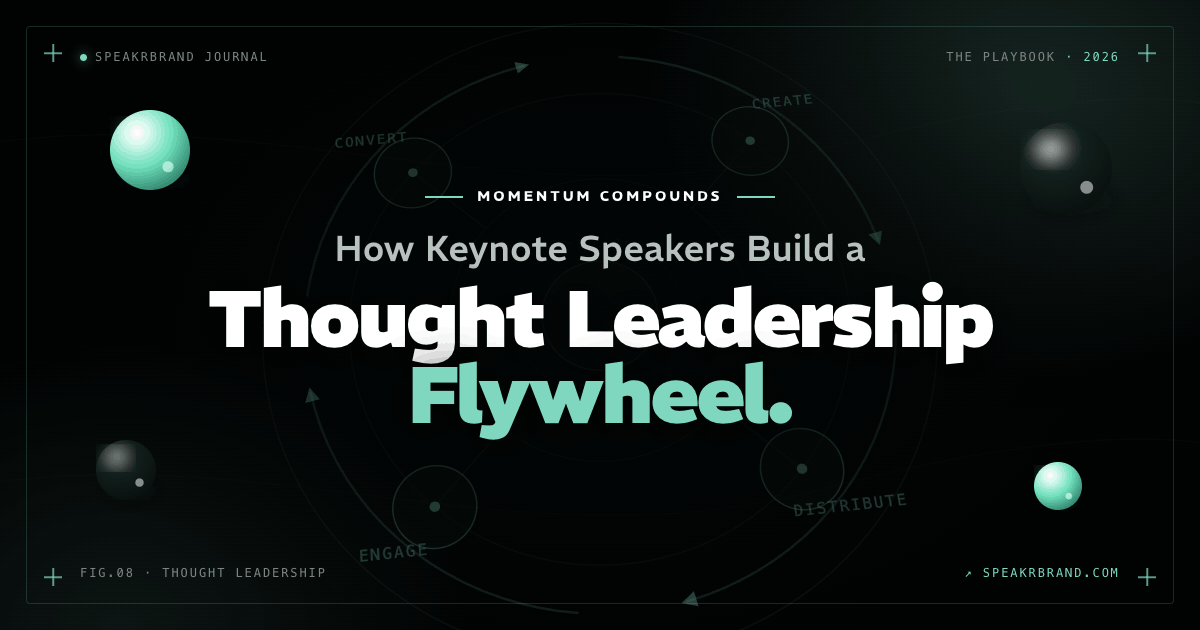
A keynote speaker builds steady inbound demand by running every platform as one connected system, a thought leadership flywheel, rather than as separate LinkedIn, YouTube, and newsletter strategies that compete for the same limited time. Positioning sits at the hub, and each platform acts as a spoke that feeds the others until the whole system produces momentum no single channel can generate alone.
The common failure is the opposite of that. A speaker spreads effort across seven platforms, manages each one independently, and ends up technically present everywhere while meaningfully present nowhere. A flywheel corrects this by giving every channel a defined job and letting one piece of content travel across all of them. It matters more than ever because planners now research across many touchpoints before they make contact. McKinsey research found that B2B buyers now use an average of ten interaction channels during a single decision, and Gartner reports that buyers spend only 17 percent of their purchase time with potential suppliers, leaving the rest to independent research where your presence either compounds or scatters.
TLDR
- A thought leadership flywheel treats all of a speaker's platforms as one system, with positioning at the hub and each platform feeding the others.
- LinkedIn is where planners and committees vet a speaker, so the profile and feed have to read as actively engaged, not dormant.
- YouTube is a search and discovery engine whose content keeps surfacing for years, unlike a social post that disappears within hours.
- Every speaker needs one owned channel, such as a newsletter, Substack, or podcast, where the relationship itself does the selling.
- Showing up in AI search results is the byproduct of doing the rest of the flywheel consistently across the credible sources answer engines already pull from.
What Is a Thought Leadership Flywheel, and Why Does It Beat Running Separate Platform Strategies?
A thought leadership flywheel is a single system in which positioning is the hub and each platform is a spoke that feeds the others, so effort compounds instead of resetting with every post. It beats running separate strategies because separate strategies spread a speaker thin and produce activity without recognition.

The hub is the clear, specific message everything else revolves around. A flywheel without a strong hub spins without going anywhere, because a message too broad to create recognition cannot make a planner stop scrolling and decide that this is the speaker for the room. With the hub in place, each spoke does a defined job and hands its output to the next one. A LinkedIn post becomes an Instagram caption. A YouTube clip drives new profile visits. A newsletter essay becomes a podcast outline. Decision-makers reward this kind of substance, and Edelman and LinkedIn research found they treat an organization's thought leadership as a more trustworthy signal of capability than its marketing materials.
The result of treating each platform as a separate strategy is a speaker who is technically present everywhere and meaningfully present nowhere.
Why Is LinkedIn the First Place Event Planners Vet a Speaker?
LinkedIn is where planners, committee members, and bureau agents validate a speaker before any conversation begins, and the first ten seconds on a profile form an impression that is difficult to change. A dormant profile does not read as neutral. It actively works against the booking.
A LinkedIn presence that works does specific things. The headline names the problem the speaker solves rather than restating the job title. The About section reads like a positioning statement instead of a resume. The content appears often enough that someone who checks the profile three weeks apart sees a speaker actively engaged in the conversations their audience cares about. Consistency is the lever here, because nine in ten decision-makers say they are more receptive to outreach from those who consistently produce high-quality thought leadership. Consider Cassandra, who had fifteen years of organizational experience but a passive profile. When she brought the same specificity to LinkedIn that she brought to the stage, the platform began to reflect the speaker she already was, and the conversations that followed changed in quality.
How Does a YouTube Library Keep Generating Booking Conversations Long After You Post?
YouTube content keeps getting found through search and recommendation for years, so a single talk uploaded once can produce booking conversations long after a social post would have vanished. It is the rare platform where a speaker's back catalog appreciates instead of expiring.

YouTube is a discovery engine as much as a video host, and its reach is unmatched. Pew Research Center found YouTube is the most widely used online platform in the United States, reaching 84 percent of adults, with a growing share using it to learn and get information. When a planner researches a name after a referral, a strong library shows how a speaker thinks and holds a room over an extended period, not just the forty-five second highlight reel on a website. A talk that resonated two years ago is still building credibility today. That footage, properly titled and consistently uploaded, becomes a search result, a search result becomes a booking conversation, and a booking conversation becomes a contract. The same library is also among the sources research tools draw from when planners look for speakers before reaching out.
Why Does Every Speaker Need One Owned Channel They Control?
Every speaker needs one channel, a newsletter, Substack, or podcast, that does not depend on an algorithm deciding whether the content gets seen and that reaches people who actively chose to hear from them. Owned attention turns the eventual booking conversation into a formality.
The distinction is concrete. Most social platforms give a speaker a follower who lives inside someone else's system and can be buried at any time. An owned channel gives a speaker an email address that travels with them and reaches a reader who raised their hand. That direct access pays off, since Litmus research puts the average return on email at 36 dollars for every dollar spent, ahead of any other channel. Substack adds a discovery layer that a standard email tool does not, letting qualified readers find a speaker and subscribe in one step. A planner who has read a speaker's newsletter for three months before they have an event to plan already trusts how that speaker sees the world.
The platform delivers the content. The relationship does the selling.
Podcast guesting is the other high-leverage option, especially earlier in building a profile. Appearing on a trusted host's show gives a speaker forty-five minutes to demonstrate how they think in front of an audience that already trusts the host, which is borrowed trust at a scale that is hard to replicate through original content alone.
How Do You Become the Speaker That AI Search Recommends?
You become that speaker by being consistently represented across the credible sources answer engines already pull from, so that when a planner asks an AI tool who to book, your name carries enough signal to be included. This visibility is earned through the rest of the flywheel, not bought.
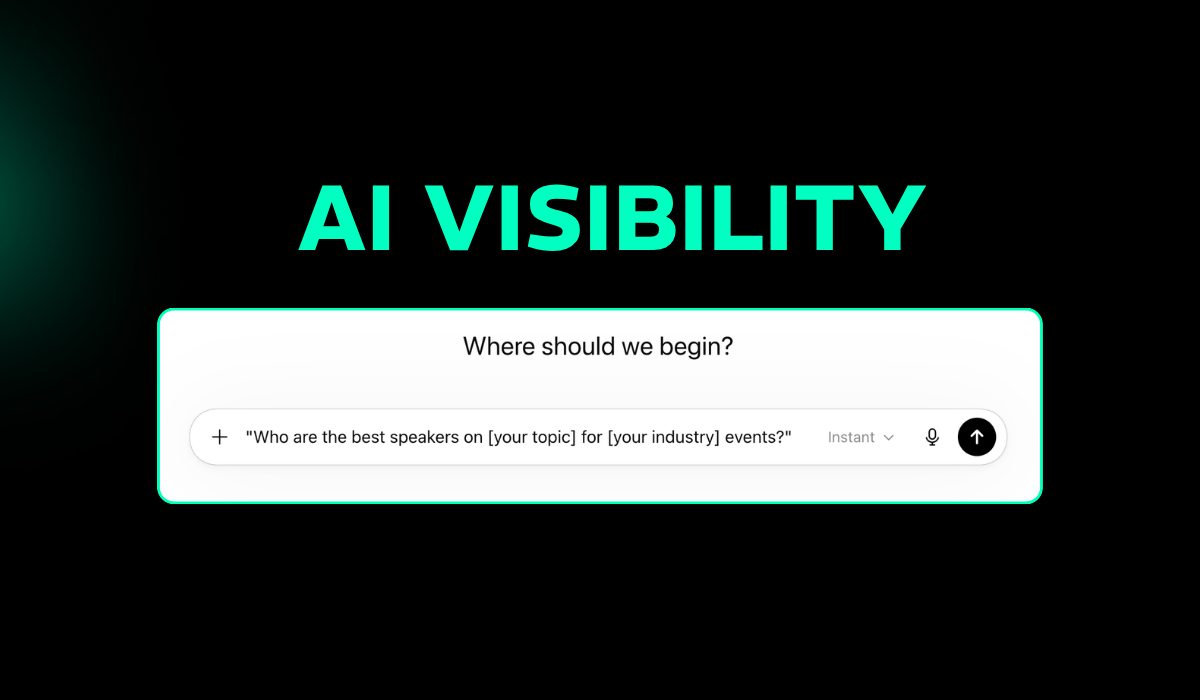
When a planner types a question like best change management keynote speakers for a financial services conference into ChatGPT, Perplexity, or Google's AI Overview, the response is a synthesized recommendation rather than a page of links. That shift is significant. Gartner predicts traditional search engine volume will fall 25 percent by 2026 as these answer engines absorb queries that once went to search. Answer Engine Optimization, sometimes called AEO or Generative Engine Optimization, is what happens when a speaker's content is specific, consistent, and distributed widely enough for those tools to have something to cite. A strong LinkedIn presence contributes signal. A YouTube library contributes signal. A newsletter with searchable archives, PR placements, and a well-positioned website each contribute signal. The speaker most consistently represented across the most credible sources, rather than the most famous, is the one most likely to be named. Managing presence across all of those surfaces at once is exactly the problem SpeakrBrand 360 was built to solve, because tracking where a speaker shows up and how consistently is the same work that determines whether an answer engine can recommend them.
Frequently Asked Questions
What is a thought leadership flywheel for speakers?
It is a single content system in which a speaker's positioning is the hub and each platform is a spoke that feeds the others. Instead of running separate strategies for each channel, the speaker creates content once and lets it move across LinkedIn, YouTube, an owned channel, and amplifiers, so the effort compounds over time.
Which platform should a speaker start with?
Most speakers should anchor on LinkedIn first, because it is where planners and committees vet them, then add YouTube for durable discovery and one owned channel they control. Trying to launch all platforms at once usually produces shallow presence everywhere, so it is better to build one spoke well before adding the next.
Why is an owned channel like a newsletter or Substack important?
An owned channel gives a speaker direct access to people who chose to hear from them, rather than followers who live inside an algorithm that can bury the content. That direct relationship builds trust ahead of any pitch, which is why an email subscriber is often worth far more than a social follower.
How do speakers show up in AI search results like ChatGPT or Google AI Overviews?
Answer engines synthesize their recommendations from content spread across credible sources, so speakers earn inclusion by being consistently represented on LinkedIn, YouTube, newsletters, PR, and their website. The speaker with the most consistent footprint across trusted sources is the one most likely to be named when a planner asks an AI tool who to consider.
How long does it take for the flywheel to produce bookings?
The flywheel does not spin instantly. The first few months feel like pushing something heavy uphill, and then the system begins to move on its own, requiring a fraction of the effort to maintain. The payoff arrives when a planner who has seen a speaker's name in several places over months finally has an event to fill and reaches out.
Presence is not about follower counts or engagement rates. It is about being known by the right people, in the right places, with enough consistency that your name is already there when a planner has a slot to fill. The planner who reaches out after seeing your work across LinkedIn, YouTube, and a newsletter did not find you. The flywheel delivered you to her, and increasingly it delivers you to the answer engines planners consult first. Decision-makers reward that kind of sustained presence, and Edelman found that 60 percent of them will pay a premium for the organizations whose thinking they trust. To build a flywheel that works across every platform and the AI tools planners now rely on, explore the systems and free strategy session at SpeakrBrand.
A keynote speaker builds steady inbound demand by running every platform as one connected system, a thought leadership flywheel, rather than as separate LinkedIn, YouTube, and newsletter strategies that compete for the same limited time. Positioning sits at the hub, and each platform acts as a spoke that feeds the others until the whole system produces momentum no single channel can generate alone.
The common failure is the opposite of that. A speaker spreads effort across seven platforms, manages each one independently, and ends up technically present everywhere while meaningfully present nowhere. A flywheel corrects this by giving every channel a defined job and letting one piece of content travel across all of them. It matters more than ever because planners now research across many touchpoints before they make contact. McKinsey research found that B2B buyers now use an average of ten interaction channels during a single decision, and Gartner reports that buyers spend only 17 percent of their purchase time with potential suppliers, leaving the rest to independent research where your presence either compounds or scatters.
TLDR
- A thought leadership flywheel treats all of a speaker's platforms as one system, with positioning at the hub and each platform feeding the others.
- LinkedIn is where planners and committees vet a speaker, so the profile and feed have to read as actively engaged, not dormant.
- YouTube is a search and discovery engine whose content keeps surfacing for years, unlike a social post that disappears within hours.
- Every speaker needs one owned channel, such as a newsletter, Substack, or podcast, where the relationship itself does the selling.
- Showing up in AI search results is the byproduct of doing the rest of the flywheel consistently across the credible sources answer engines already pull from.
What Is a Thought Leadership Flywheel, and Why Does It Beat Running Separate Platform Strategies?
A thought leadership flywheel is a single system in which positioning is the hub and each platform is a spoke that feeds the others, so effort compounds instead of resetting with every post. It beats running separate strategies because separate strategies spread a speaker thin and produce activity without recognition.
The hub is the clear, specific message everything else revolves around. A flywheel without a strong hub spins without going anywhere, because a message too broad to create recognition cannot make a planner stop scrolling and decide that this is the speaker for the room. With the hub in place, each spoke does a defined job and hands its output to the next one. A LinkedIn post becomes an Instagram caption. A YouTube clip drives new profile visits. A newsletter essay becomes a podcast outline. Decision-makers reward this kind of substance, and Edelman and LinkedIn research found they treat an organization's thought leadership as a more trustworthy signal of capability than its marketing materials.
The result of treating each platform as a separate strategy is a speaker who is technically present everywhere and meaningfully present nowhere.
Why Is LinkedIn the First Place Event Planners Vet a Speaker?
LinkedIn is where planners, committee members, and bureau agents validate a speaker before any conversation begins, and the first ten seconds on a profile form an impression that is difficult to change. A dormant profile does not read as neutral. It actively works against the booking.
A LinkedIn presence that works does specific things. The headline names the problem the speaker solves rather than restating the job title. The About section reads like a positioning statement instead of a resume. The content appears often enough that someone who checks the profile three weeks apart sees a speaker actively engaged in the conversations their audience cares about. Consistency is the lever here, because nine in ten decision-makers say they are more receptive to outreach from those who consistently produce high-quality thought leadership. Consider Cassandra, who had fifteen years of organizational experience but a passive profile. When she brought the same specificity to LinkedIn that she brought to the stage, the platform began to reflect the speaker she already was, and the conversations that followed changed in quality.
How Does a YouTube Library Keep Generating Booking Conversations Long After You Post?
YouTube content keeps getting found through search and recommendation for years, so a single talk uploaded once can produce booking conversations long after a social post would have vanished. It is the rare platform where a speaker's back catalog appreciates instead of expiring.
YouTube is a discovery engine as much as a video host, and its reach is unmatched. Pew Research Center found YouTube is the most widely used online platform in the United States, reaching 84 percent of adults, with a growing share using it to learn and get information. When a planner researches a name after a referral, a strong library shows how a speaker thinks and holds a room over an extended period, not just the forty-five second highlight reel on a website. A talk that resonated two years ago is still building credibility today. That footage, properly titled and consistently uploaded, becomes a search result, a search result becomes a booking conversation, and a booking conversation becomes a contract. The same library is also among the sources research tools draw from when planners look for speakers before reaching out.
Why Does Every Speaker Need One Owned Channel They Control?
Every speaker needs one channel, a newsletter, Substack, or podcast, that does not depend on an algorithm deciding whether the content gets seen and that reaches people who actively chose to hear from them. Owned attention turns the eventual booking conversation into a formality.
The distinction is concrete. Most social platforms give a speaker a follower who lives inside someone else's system and can be buried at any time. An owned channel gives a speaker an email address that travels with them and reaches a reader who raised their hand. That direct access pays off, since Litmus research puts the average return on email at 36 dollars for every dollar spent, ahead of any other channel. Substack adds a discovery layer that a standard email tool does not, letting qualified readers find a speaker and subscribe in one step. A planner who has read a speaker's newsletter for three months before they have an event to plan already trusts how that speaker sees the world.
The platform delivers the content. The relationship does the selling.
Podcast guesting is the other high-leverage option, especially earlier in building a profile. Appearing on a trusted host's show gives a speaker forty-five minutes to demonstrate how they think in front of an audience that already trusts the host, which is borrowed trust at a scale that is hard to replicate through original content alone.
How Do You Become the Speaker That AI Search Recommends?
You become that speaker by being consistently represented across the credible sources answer engines already pull from, so that when a planner asks an AI tool who to book, your name carries enough signal to be included. This visibility is earned through the rest of the flywheel, not bought.
When a planner types a question like best change management keynote speakers for a financial services conference into ChatGPT, Perplexity, or Google's AI Overview, the response is a synthesized recommendation rather than a page of links. That shift is significant. Gartner predicts traditional search engine volume will fall 25 percent by 2026 as these answer engines absorb queries that once went to search. Answer Engine Optimization, sometimes called AEO or Generative Engine Optimization, is what happens when a speaker's content is specific, consistent, and distributed widely enough for those tools to have something to cite. A strong LinkedIn presence contributes signal. A YouTube library contributes signal. A newsletter with searchable archives, PR placements, and a well-positioned website each contribute signal. The speaker most consistently represented across the most credible sources, rather than the most famous, is the one most likely to be named. Managing presence across all of those surfaces at once is exactly the problem SpeakrBrand 360 was built to solve, because tracking where a speaker shows up and how consistently is the same work that determines whether an answer engine can recommend them.
Frequently Asked Questions
What is a thought leadership flywheel for speakers?
It is a single content system in which a speaker's positioning is the hub and each platform is a spoke that feeds the others. Instead of running separate strategies for each channel, the speaker creates content once and lets it move across LinkedIn, YouTube, an owned channel, and amplifiers, so the effort compounds over time.
Which platform should a speaker start with?
Most speakers should anchor on LinkedIn first, because it is where planners and committees vet them, then add YouTube for durable discovery and one owned channel they control. Trying to launch all platforms at once usually produces shallow presence everywhere, so it is better to build one spoke well before adding the next.
Why is an owned channel like a newsletter or Substack important?
An owned channel gives a speaker direct access to people who chose to hear from them, rather than followers who live inside an algorithm that can bury the content. That direct relationship builds trust ahead of any pitch, which is why an email subscriber is often worth far more than a social follower.
How do speakers show up in AI search results like ChatGPT or Google AI Overviews?
Answer engines synthesize their recommendations from content spread across credible sources, so speakers earn inclusion by being consistently represented on LinkedIn, YouTube, newsletters, PR, and their website. The speaker with the most consistent footprint across trusted sources is the one most likely to be named when a planner asks an AI tool who to consider.
How long does it take for the flywheel to produce bookings?
The flywheel does not spin instantly. The first few months feel like pushing something heavy uphill, and then the system begins to move on its own, requiring a fraction of the effort to maintain. The payoff arrives when a planner who has seen a speaker's name in several places over months finally has an event to fill and reaches out.
Presence is not about follower counts or engagement rates. It is about being known by the right people, in the right places, with enough consistency that your name is already there when a planner has a slot to fill. The planner who reaches out after seeing your work across LinkedIn, YouTube, and a newsletter did not find you. The flywheel delivered you to her, and increasingly it delivers you to the answer engines planners consult first. Decision-makers reward that kind of sustained presence, and Edelman found that 60 percent of them will pay a premium for the organizations whose thinking they trust. To build a flywheel that works across every platform and the AI tools planners now rely on, explore the systems and free strategy session at SpeakrBrand.

.png)
