Authors can write LinkedIn posts the way they speak by talking first and typing second: say the idea out loud, capture it with a voice memo or dictation, then cut the transcript down without polishing the personality out of it. The voice readers met in the book, and the voice audiences hear at a reading or on a podcast, is the voice that should show up in the feed.
That sounds obvious. In practice, plenty of authors who are warm and specific in conversation turn stiff the moment they open the LinkedIn post box. The sentences get longer, the words get bigger, and the post starts to sound like a back-cover blurb. This guide covers why that happens, why it costs more on LinkedIn now than it did two years ago, and a five-step method to fix it.
TLDR
- Authors tend to write in a formal “desk voice” on LinkedIn, even when they speak plainly and well.
- LinkedIn is now reducing the reach of generic, AI-sounding posts, so a recognizable human voice matters more than polish.
- The fastest fix is a talk-first draft: record 60 to 90 seconds, transcribe it, cut it, and read it out loud.
- Edit for clarity. Keep the fragments, asides, and phrases you actually use.
- Talk about real material: a reader’s question, a chapter you almost cut, a mistake, a result.
Why Do Authors Sound Different on LinkedIn Than They Do in Person?
Authors sound different on LinkedIn because writing pulls people into a more formal register than speaking does, and expertise makes it worse. The more you know about a subject, the easier it is to forget what a new reader does not know.
Steven Pinker, the Harvard psychologist and author of several bestselling books on language, calls this the curse of knowledge. In his essay on why academic writing goes wrong, he describes it as “a difficulty in imagining what it is like for someone else not to know something that you know.” Pinker’s alternative, which he calls classic style, treats writing as a conversation with the reader. Authors who have spent two years inside a manuscript are especially exposed to the curse, because the book’s vocabulary has become their everyday vocabulary.
The essayist and investor Paul Graham made the same point in plainer terms in Write Like You Talk. People, he wrote, “write in a different language than they’d use if they were talking to a friend.” His test for every sentence is simple: is this the way you would say it to a friend? If not, say it that way instead.
“Informal language is the athletic clothing of ideas.” Paul Graham, Write Like You Talk
Bigger words also work against you. Princeton psychologist Daniel Oppenheimer won an Ig Nobel Prize for a 2006 study in which needlessly complex wording led readers to rate writers lower. The Daily Princetonian summarized his conclusion this way: “the use of overly complex words leads to lower evaluations of a text’s author.” Harvard Business Review gives the same advice for work writing: choose shorter, more familiar words and aim for “one thought per sentence.”
Why Does Sounding Like Yourself Matter More on LinkedIn Now?
Sounding like yourself matters more on LinkedIn now because most long posts no longer sound like anyone in particular, and LinkedIn has started to filter for that. A post that reads like a real person stands out from a feed full of the same voice.
Originality.ai has tracked AI-written content on LinkedIn since 2024. In its July 2026 study of 5,000 public LinkedIn posts of 100 words or more, 81.2% were classified as likely AI-generated, up from roughly half of sampled long-form posts in late 2024. Readers have noticed. LinkedIn reports that more than one million members used its new “Seems like AI slop” feedback button within two weeks of its August 2026 launch, and that views of content classified as AI slop have dropped 40%. LinkedIn defines that content as posts that “may sound polished on the surface” but lack “a clear point of view, unique perspective, or substance.”
LinkedIn has not banned AI help. Its best practices for content created with the help of AI say AI-assisted content is welcome when it reflects a real person’s perspective, and that generic posts are less likely to be widely distributed.
“AI might be a tool, but it is not a magic wand.” LinkedIn Help, Best practices for content created with the help of AI
Quality was already a problem before the AI wave. In the 2024 LinkedIn and Edelman B2B thought leadership research, only 15% of decision-makers described the thought leadership they read as very good, and earlier LinkedIn and Edelman research found 55% of buyers will move on if content does not catch their interest within the first minute. For an author, that first minute is usually the first two lines of a post. A line you would actually say out loud gives a reader a reason to keep going.
How Can Authors Turn Talking Into a LinkedIn Post?
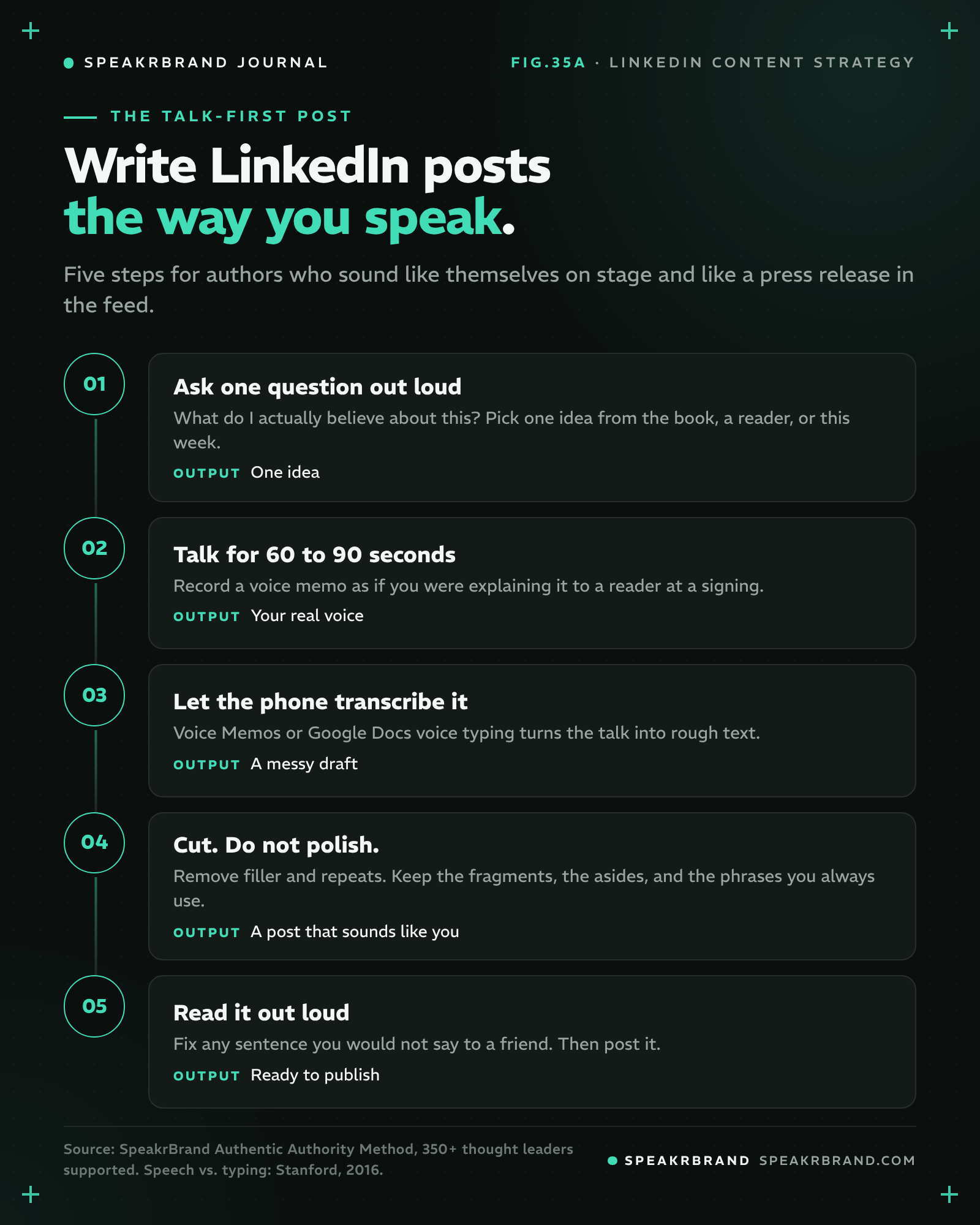
FIG.35A · The talk-first post: five steps from voice memo to LinkedIn. Tap to open full size.
Authors can turn talking into a LinkedIn post with a five-step talk-first method: ask one question, talk for 60 to 90 seconds, let the phone transcribe it, cut without polishing, and read it out loud before posting.
- Ask one question out loud. “What do I actually believe about this?” Pick one idea: a chapter, a reader’s email, a question from the last event.
- Talk for 60 to 90 seconds. Picture one reader at a signing table and explain the idea to them. Do not read from notes.
- Let the phone transcribe it. On a recent iPhone, Voice Memos can transcribe a recording and copy the full transcript. In a browser, Google Docs voice typing turns speech into text as you talk.
- Cut. Do not polish. Remove filler, false starts, and repeats. Keep the fragments, the asides in parentheses, and the phrases you always use. That is where your voice lives.
- Read it out loud. Fix any sentence you would not say to a friend, then post it.
Speed is part of the appeal. A Stanford-led study of smartphone text entry found speech recognition was three times faster than typing in English, with a 20.4% lower error rate. For an author juggling a manuscript, events, and a launch plan, three times faster is the difference between posting this week and meaning to.
Try this first
Before you type your next LinkedIn post, open a voice memo and answer one question out loud: “What do I actually believe about this?” Talk for 60 to 90 seconds, copy the transcript, and cut it down without adding a single new sentence.
How Do You Edit a Spoken Draft Without Losing Your Voice?

FIG.35B · Desk voice vs. talk voice: seven swaps for authors on LinkedIn. Tap to open full size.
You edit a spoken draft by cutting for clarity and leaving the personality alone. The goal is a post that reads cleanly and still sounds like you, so every edit should remove something that gets in the reader’s way, never add something that sounds more impressive.
Ann Handley, the author of Everybody Writes, puts the editing mindset well in her 13 writing rules: “No one will ever complain that you’ve made things too simple to understand,” and “Buzzwords and jargon are the chemical additives of writing.” She also notes that good writers are often terrible first-draft writers who happen to be excellent editors of their own work. A transcript is a perfect ugly first draft: it already has your rhythm, and it only needs trimming.
Run every spoken draft through five quick checks before it goes live:
| Voice check | Ask yourself | The fix |
|---|---|---|
| The friend test | Would I say this sentence to a friend over coffee? | Rewrite it the way you would say it out loud. |
| The word test | Is there a shorter, more familiar word? | Use for utilize. Help for facilitate. Start for commence. |
| The breath test | Can I read this sentence in one breath? | Split it. One thought per sentence. |
| The detail test | Is there a name, number, or moment only I know? | Add one from a reader, a chapter, or this week. |
| The read-aloud test | Did anything sound stiff when I said it? | Fix it or cut it before you post. |
On a phone, swipe the table sideways to see every column.
AI can help with this step when it stays in its lane. Ask it to remove filler words or fix punctuation in your transcript. Do not ask it to make the post more engaging, add a hook, or invent an example. At SpeakrBrand, the working rule for the Authentic Authority Method is that AI asks, listens, and organizes. It never invents.
AI can write the post. It can’t live the story. The details that make a LinkedIn post sound like you are the ones only you were there for.
What Should Authors Talk About When They Hit Record?
Authors should talk about the material only they have: the reader who wrote in, the chapter that almost did not make the book, the research finding that surprised them, and the mistake they made along the way. Those topics are easy to say out loud because you already know them by heart.
SpeakrBrand’s Authentic Authority method sorts posts into four buckets: Stories (what you have lived), Personal (who you are), Insights (what you know), and Proof (what you have done). Each one gives an author an easy prompt for a voice memo:
- Stories: “The moment I realized this book had to be written was...”
- Personal: “Here is what my writing day actually looks like right now.”
- Insights: “Most people in my field believe this. I think they are wrong, and here is why.”
- Proof: “A reader wrote to me last week and told me what changed after chapter four.”
If you are planning a launch, the Top 20 Book Launch LinkedIn Ideas for Authors in 2027 gives you a full list of prompts to record, and the guide on building a LinkedIn audience in the 90 days before a book launch shows how to sequence them. Across the 350+ thought leaders SpeakrBrand has supported, the posts that sound most like the person tend to come from the same place: a recorded conversation, long before anyone opens a blank page.
Frequently Asked Questions
How do I make my LinkedIn posts sound more like me?
Talk before you type. Record a 60 to 90 second voice memo explaining one idea to one person, transcribe it, and cut it down without rewriting it in a more formal tone. Then read it out loud and fix anything you would not actually say.
Is it okay for authors to use AI to write LinkedIn posts?
Yes, as long as the ideas, stories, and point of view are yours. LinkedIn says AI-assisted content is welcome when it reflects a real person’s perspective, while generic posts are less likely to be widely distributed. Use AI to clean up a transcript and keep the substance yours.
What is the best way to dictate a LinkedIn post?
Use the tools already on your phone or laptop. Apple Voice Memos can transcribe recordings on recent iPhones, and Google Docs voice typing works in the browser. Speak in short bursts, then edit the text in one pass.
Should my LinkedIn voice match the voice in my book?
Your LinkedIn voice should sound like the same person, even if it is looser than the book. Readers who meet you in the feed should recognize the author when they open the book, and the other way around. A conversational post is often closer to how you sound at a reading than the edited manuscript is.
How long should an author’s LinkedIn post be?
Long enough to make one point well, which for a talk-first draft usually means the 60 to 90 seconds you recorded, trimmed by about a third. One idea per post keeps it readable on a phone and easy to finish.
Your book already has a voice. Your LinkedIn feed should sound like the same person. Record one voice memo this week and turn it into a post before you open a blank page. If you want help turning your book, talks, and stories into a steady LinkedIn presence that earns trust before hello, SpeakrBrand’s social media marketing team builds LinkedIn content strategy for authors and speakers in their own voice.
Authors can write LinkedIn posts the way they speak by talking first and typing second: say the idea out loud, capture it with a voice memo or dictation, then cut the transcript down without polishing the personality out of it. The voice readers met in the book, and the voice audiences hear at a reading or on a podcast, is the voice that should show up in the feed.
That sounds obvious. In practice, plenty of authors who are warm and specific in conversation turn stiff the moment they open the LinkedIn post box. The sentences get longer, the words get bigger, and the post starts to sound like a back-cover blurb. This guide covers why that happens, why it costs more on LinkedIn now than it did two years ago, and a five-step method to fix it.
TLDR
- Authors tend to write in a formal “desk voice” on LinkedIn, even when they speak plainly and well.
- LinkedIn is now reducing the reach of generic, AI-sounding posts, so a recognizable human voice matters more than polish.
- The fastest fix is a talk-first draft: record 60 to 90 seconds, transcribe it, cut it, and read it out loud.
- Edit for clarity. Keep the fragments, asides, and phrases you actually use.
- Talk about real material: a reader’s question, a chapter you almost cut, a mistake, a result.
Why Do Authors Sound Different on LinkedIn Than They Do in Person?
Authors sound different on LinkedIn because writing pulls people into a more formal register than speaking does, and expertise makes it worse. The more you know about a subject, the easier it is to forget what a new reader does not know.
Steven Pinker, the Harvard psychologist and author of several bestselling books on language, calls this the curse of knowledge. In his essay on why academic writing goes wrong, he describes it as “a difficulty in imagining what it is like for someone else not to know something that you know.” Pinker’s alternative, which he calls classic style, treats writing as a conversation with the reader. Authors who have spent two years inside a manuscript are especially exposed to the curse, because the book’s vocabulary has become their everyday vocabulary.
The essayist and investor Paul Graham made the same point in plainer terms in Write Like You Talk. People, he wrote, “write in a different language than they’d use if they were talking to a friend.” His test for every sentence is simple: is this the way you would say it to a friend? If not, say it that way instead.
“Informal language is the athletic clothing of ideas.” Paul Graham, Write Like You Talk
Bigger words also work against you. Princeton psychologist Daniel Oppenheimer won an Ig Nobel Prize for a 2006 study in which needlessly complex wording led readers to rate writers lower. The Daily Princetonian summarized his conclusion this way: “the use of overly complex words leads to lower evaluations of a text’s author.” Harvard Business Review gives the same advice for work writing: choose shorter, more familiar words and aim for “one thought per sentence.”
Why Does Sounding Like Yourself Matter More on LinkedIn Now?
Sounding like yourself matters more on LinkedIn now because most long posts no longer sound like anyone in particular, and LinkedIn has started to filter for that. A post that reads like a real person stands out from a feed full of the same voice.
Originality.ai has tracked AI-written content on LinkedIn since 2024. In its July 2026 study of 5,000 public LinkedIn posts of 100 words or more, 81.2% were classified as likely AI-generated, up from roughly half of sampled long-form posts in late 2024. Readers have noticed. LinkedIn reports that more than one million members used its new “Seems like AI slop” feedback button within two weeks of its August 2026 launch, and that views of content classified as AI slop have dropped 40%. LinkedIn defines that content as posts that “may sound polished on the surface” but lack “a clear point of view, unique perspective, or substance.”
LinkedIn has not banned AI help. Its best practices for content created with the help of AI say AI-assisted content is welcome when it reflects a real person’s perspective, and that generic posts are less likely to be widely distributed.
“AI might be a tool, but it is not a magic wand.” LinkedIn Help, Best practices for content created with the help of AI
Quality was already a problem before the AI wave. In the 2024 LinkedIn and Edelman B2B thought leadership research, only 15% of decision-makers described the thought leadership they read as very good, and earlier LinkedIn and Edelman research found 55% of buyers will move on if content does not catch their interest within the first minute. For an author, that first minute is usually the first two lines of a post. A line you would actually say out loud gives a reader a reason to keep going.
How Can Authors Turn Talking Into a LinkedIn Post?
FIG.35A · The talk-first post: five steps from voice memo to LinkedIn. Tap to open full size.
Authors can turn talking into a LinkedIn post with a five-step talk-first method: ask one question, talk for 60 to 90 seconds, let the phone transcribe it, cut without polishing, and read it out loud before posting.
- Ask one question out loud. “What do I actually believe about this?” Pick one idea: a chapter, a reader’s email, a question from the last event.
- Talk for 60 to 90 seconds. Picture one reader at a signing table and explain the idea to them. Do not read from notes.
- Let the phone transcribe it. On a recent iPhone, Voice Memos can transcribe a recording and copy the full transcript. In a browser, Google Docs voice typing turns speech into text as you talk.
- Cut. Do not polish. Remove filler, false starts, and repeats. Keep the fragments, the asides in parentheses, and the phrases you always use. That is where your voice lives.
- Read it out loud. Fix any sentence you would not say to a friend, then post it.
Speed is part of the appeal. A Stanford-led study of smartphone text entry found speech recognition was three times faster than typing in English, with a 20.4% lower error rate. For an author juggling a manuscript, events, and a launch plan, three times faster is the difference between posting this week and meaning to.
Try this first
Before you type your next LinkedIn post, open a voice memo and answer one question out loud: “What do I actually believe about this?” Talk for 60 to 90 seconds, copy the transcript, and cut it down without adding a single new sentence.
How Do You Edit a Spoken Draft Without Losing Your Voice?
FIG.35B · Desk voice vs. talk voice: seven swaps for authors on LinkedIn. Tap to open full size.
You edit a spoken draft by cutting for clarity and leaving the personality alone. The goal is a post that reads cleanly and still sounds like you, so every edit should remove something that gets in the reader’s way, never add something that sounds more impressive.
Ann Handley, the author of Everybody Writes, puts the editing mindset well in her 13 writing rules: “No one will ever complain that you’ve made things too simple to understand,” and “Buzzwords and jargon are the chemical additives of writing.” She also notes that good writers are often terrible first-draft writers who happen to be excellent editors of their own work. A transcript is a perfect ugly first draft: it already has your rhythm, and it only needs trimming.
Run every spoken draft through five quick checks before it goes live:
| Voice check | Ask yourself | The fix |
|---|---|---|
| The friend test | Would I say this sentence to a friend over coffee? | Rewrite it the way you would say it out loud. |
| The word test | Is there a shorter, more familiar word? | Use for utilize. Help for facilitate. Start for commence. |
| The breath test | Can I read this sentence in one breath? | Split it. One thought per sentence. |
| The detail test | Is there a name, number, or moment only I know? | Add one from a reader, a chapter, or this week. |
| The read-aloud test | Did anything sound stiff when I said it? | Fix it or cut it before you post. |
On a phone, swipe the table sideways to see every column.
AI can help with this step when it stays in its lane. Ask it to remove filler words or fix punctuation in your transcript. Do not ask it to make the post more engaging, add a hook, or invent an example. At SpeakrBrand, the working rule for the Authentic Authority Method is that AI asks, listens, and organizes. It never invents.
AI can write the post. It can’t live the story. The details that make a LinkedIn post sound like you are the ones only you were there for.
What Should Authors Talk About When They Hit Record?
Authors should talk about the material only they have: the reader who wrote in, the chapter that almost did not make the book, the research finding that surprised them, and the mistake they made along the way. Those topics are easy to say out loud because you already know them by heart.
SpeakrBrand’s Authentic Authority method sorts posts into four buckets: Stories (what you have lived), Personal (who you are), Insights (what you know), and Proof (what you have done). Each one gives an author an easy prompt for a voice memo:
- Stories: “The moment I realized this book had to be written was...”
- Personal: “Here is what my writing day actually looks like right now.”
- Insights: “Most people in my field believe this. I think they are wrong, and here is why.”
- Proof: “A reader wrote to me last week and told me what changed after chapter four.”
If you are planning a launch, the Top 20 Book Launch LinkedIn Ideas for Authors in 2027 gives you a full list of prompts to record, and the guide on building a LinkedIn audience in the 90 days before a book launch shows how to sequence them. Across the 350+ thought leaders SpeakrBrand has supported, the posts that sound most like the person tend to come from the same place: a recorded conversation, long before anyone opens a blank page.
Frequently Asked Questions
How do I make my LinkedIn posts sound more like me?
Talk before you type. Record a 60 to 90 second voice memo explaining one idea to one person, transcribe it, and cut it down without rewriting it in a more formal tone. Then read it out loud and fix anything you would not actually say.
Is it okay for authors to use AI to write LinkedIn posts?
Yes, as long as the ideas, stories, and point of view are yours. LinkedIn says AI-assisted content is welcome when it reflects a real person’s perspective, while generic posts are less likely to be widely distributed. Use AI to clean up a transcript and keep the substance yours.
What is the best way to dictate a LinkedIn post?
Use the tools already on your phone or laptop. Apple Voice Memos can transcribe recordings on recent iPhones, and Google Docs voice typing works in the browser. Speak in short bursts, then edit the text in one pass.
Should my LinkedIn voice match the voice in my book?
Your LinkedIn voice should sound like the same person, even if it is looser than the book. Readers who meet you in the feed should recognize the author when they open the book, and the other way around. A conversational post is often closer to how you sound at a reading than the edited manuscript is.
How long should an author’s LinkedIn post be?
Long enough to make one point well, which for a talk-first draft usually means the 60 to 90 seconds you recorded, trimmed by about a third. One idea per post keeps it readable on a phone and easy to finish.
Your book already has a voice. Your LinkedIn feed should sound like the same person. Record one voice memo this week and turn it into a post before you open a blank page. If you want help turning your book, talks, and stories into a steady LinkedIn presence that earns trust before hello, SpeakrBrand’s social media marketing team builds LinkedIn content strategy for authors and speakers in their own voice.